

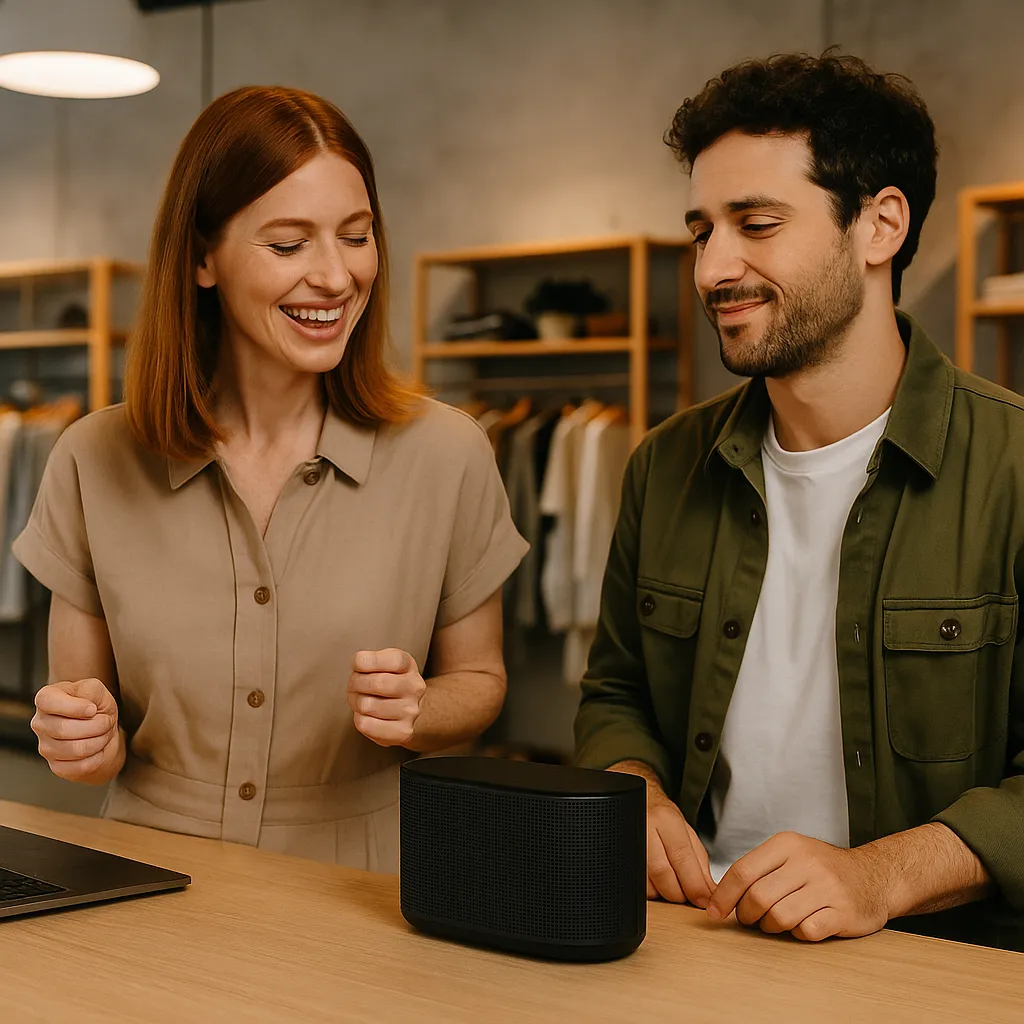
Traditional marketing, based almost exclusively on images and text, is increasingly giving way to a multisensory approach where the customer experience takes center stage. Sensory marketing today is a rapidly evolving discipline that integrates innovative technological tools to engage not only sight but also hearing, smell, and touch.
Among all the senses, hearing plays a privileged role: music and voice can directly touch emotions, create atmospheres, evoke memories, and influence buying behaviors. How important is it for you that the music in a store or the voice you hear is consistent with that brand’s identity?
This question is at the heart of a paradigm shift: these elements are no longer left to chance but become an integral part of digital strategies that leverage artificial intelligence to create tailored and dynamic experiences.
Today, sensory marketing is no longer a trend but a necessity for brands that want to stand out and remain memorable in customers’ minds and hearts.
Music as an emotional and strategic foundation
Music is the most traditional and powerful lever in sensory marketing. It’s no longer just about choosing a generic playlist to play in the background but building a custom-designed sound journey.
Imagine a store that adapts its playlist based on the time of day: energetic rhythms in the morning to welcome customers, relaxing sounds in the afternoon to encourage longer stays.
Dynamic playlists, built and optimized with the help of algorithms, can change according to the time, the flow of people, or ongoing promotional campaigns. This keeps attention high, positively stimulates the experience, and influences purchasing choices.
For a deeper dive, read our article on in-store radio and musical emotions in commercial activities.
In many successful cases in retail and hospitality, music has created a strong emotional bond with customers, resulting in increased sales and loyalty.
Voice as a personality and relationship element
Voice is a direct channel to establish an immediate and authentic relationship with the customer. Vocal spots, branded messages, or personalized announcements clearly communicate values and promotions, creating a consistent atmosphere.
AI-assisted voice production requires appropriate permissions and human review. Available features and any real-time integration must be confirmed for the specific offer.
Learn more about innovative voice use with our article on Text-to-Speech and Voice Cloning in marketing.
Voice has a very strong emotional impact, increasing engagement and memorability.
AI transforming sound marketing
AI can support music and voice content production under human supervision. Available features and integrations must be checked in the offer: automatic adaptation to sales, sensors or visitor data should not be assumed.
AI can support music and voice content production under human supervision. Available features and integrations must be checked in the offer: automatic adaptation to sales, sensors or visitor data should not be assumed.
To learn more about AI’s role, visit MIT Technology Review.
This paves the way for interactive, contextual, and scalable sound marketing, where the experience evolves dynamically.
How to integrate the 3 levers into your strategy
The real effectiveness comes from integrating music, voice, and AI: a coherent and engaging ecosystem.
The 14-day free trial is for internal technical evaluation only and does not authorise public performance in premises open to the public. The commercial licence requires the first payment and final activation.
We recommend starting with a pilot project in one or a few stores to test and optimize the best combination.
Measuring success with clear KPIs such as dwell time, conversion rate, and customer satisfaction is essential to improve and scale.
The scent experience with OLFICE
We are developing an exclusive project that combines the power of sound with a unique multisensory experience, integrating aroma, atmosphere, and technology.
The scent experience with OLFICE complements work on the venue’s atmosphere. Fragrances, diffusion, included services and management arrangements are defined according to the project and applicable offer.
Mini-box: some data on sensory marketing
- Assess the project using documented observations on comfort, message clarity and coherence with the venue. Any commercial results require analysis of the context.
- Assess the project using documented observations on comfort, message clarity and coherence with the venue. Any commercial results require analysis of the context.
- Assess the project using documented observations on comfort, message clarity and coherence with the venue. Any commercial results require analysis of the context.
FAQ – frequently asked questions
- What is sensory marketing?
It is a strategy that involves multiple senses to create memorable experiences and influence purchasing decisions. - AI can support music and voice content production under human supervision. Available features and integrations must be checked in the offer: automatic adaptation to sales, sensors or visitor data should not be assumed.
- What are the benefits of vocal spots?
Vocal spots create a direct and immediate connection with the customer, increase engagement, and strengthen brand identity. - Do I need a dedicated team to manage all this?
Not necessarily. With MoosBox’s integrated platform and professional services, we make management easier, even without deep technical skills.
Don’t miss any MoosBox updates — follow us on LinkedIn or join our Telegram channel.