Your shop’s music should not become another job for your team. It should suit the brand, make the space welcoming and work consistently throughout the trading day. Staff should not need to source tracks, manage playlists or interpret music licensing terms.
AI can generate a track quickly. That is not the same as running a dependable in-store music service. Curation, scheduling, playback, support and clear licensing still matter. MoosBox brings those elements together with a curated catalogue and documented direct licences for the repertoire and uses covered by the agreement.
For a retailer, the difference is practical: less work for staff, consistent programming and a clearer understanding of what the service authorises. That is why a playlist alone is not enough.
What MoosBox actually provides
MoosBox is not simply a collection of audio files. It provides curated music, scheduling and Mood programming, compatible playback options and support according to the plan. For multi-site retailers, centralised management helps maintain a recognisable sound across stores while coordinating different operating needs.
Its documented direct licence applies to the service’s repertoire and the uses and territories defined in the agreement. It is not a blanket promise that every local statutory payment disappears. Any additional obligations depend on the country and circumstances. Being clear about that distinction is part of choosing a dependable service.
Commercial use does not mean unlimited use
A commercial-use licence might cover advertising, social content, live events or playback in a physical venue. Those are different uses and should not be assumed to come with every subscription. Keep a record of the terms applying to each track when it is created or purchased.
The practical question is whether the licence actually covers public playback in commercial premises, in the relevant territory, and whether any separate statutory payments apply. A broad reference to commercial use is not enough to establish all of that. A retailer needs permissions it can document and a clear understanding of what its music service does and does not cover.
Do AI tracks require PRS or PPL licensing in the UK?
You cannot answer that question from the words “AI-generated” alone. The answer depends on the rights involved, the recording, the permissions granted and the legal framework. PRS and PPL administer different categories of music rights. Whether a payment is required depends on the actual repertoire and usage. A platform’s permission for commercial use is relevant evidence, not a universal substitute for checking public-performance and related rights.
Licence certainty is part of the service
Businesses need clear contractual documentation specifying which repertoire, territories, premises and forms of playback are covered. MoosBox provides a curated catalogue under a documented direct licence, subject to the repertoire, territory and uses defined in the agreement. That coverage does not automatically extend to third-party tracks, customer uploads or uses outside the contract. Public playback authorisation applies after payment and full service activation, not during a free trial.
What needs to work on the shop floor
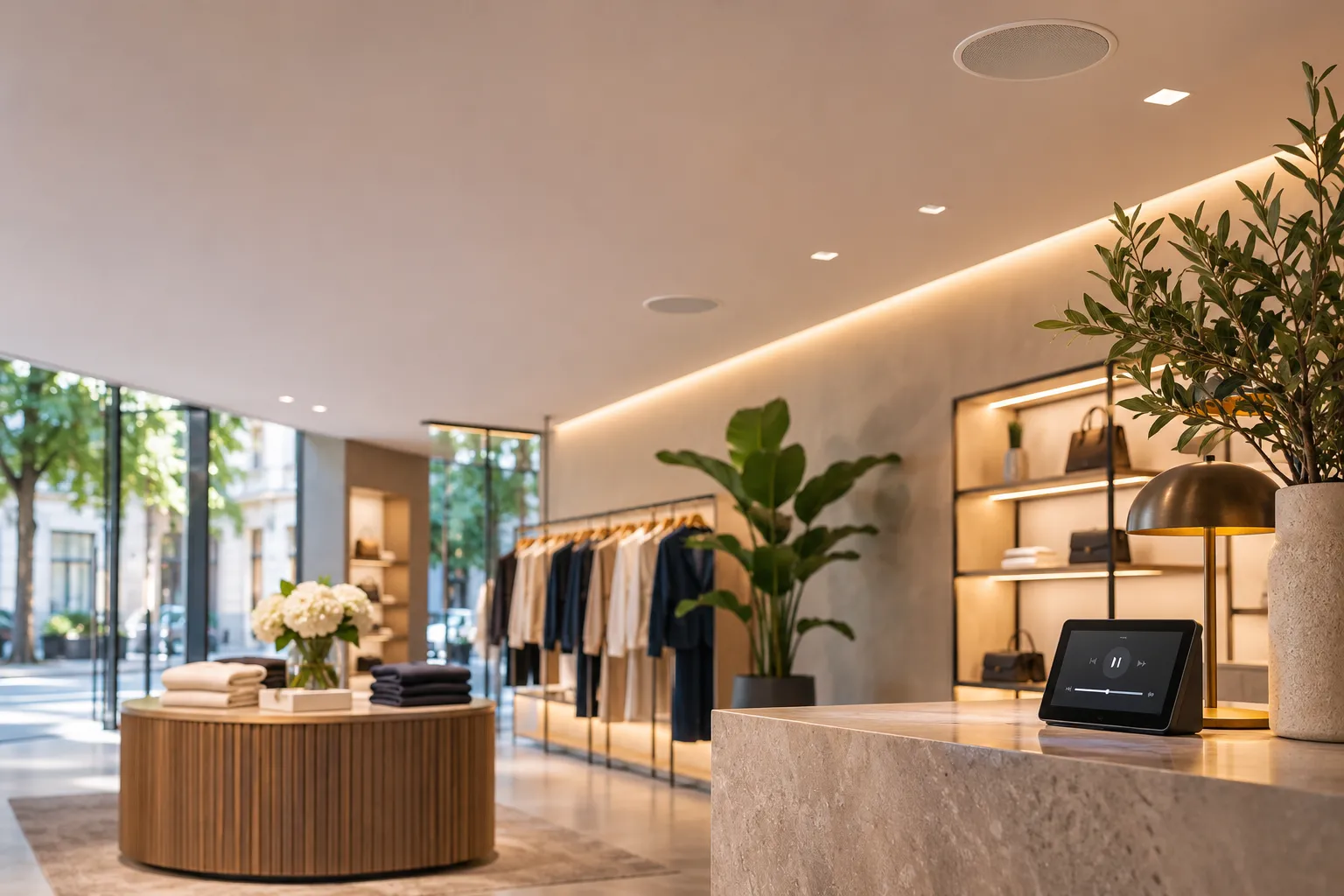
Music plays throughout the trading day. A quieter morning, a busy afternoon and a seasonal promotion may call for different programming. Some premises also need separate audio zones or scheduled announcements. Staff should not have to become music programmers to make these decisions work.
A track being licensed does not automatically make it suitable. Curation also considers the brand, customers, energy level, variety and how long people spend in the space. A large collection is not the same as a coherent listening experience.
Sound identity still requires editorial judgement
A premium boutique and a fast-moving convenience store should not necessarily sound alike. Musical direction translates brand positioning into choices about genre, tempo, intensity, scheduling and exclusions. AI may support music creation, but it does not decide whether the resulting programme is right for a particular retail environment.
Why multi-site retail changes the requirements
Once a business operates ten, thirty or a hundred locations, separate playlists become difficult to control. Head office needs consistent rules, coordinated campaigns and visibility across stores, while still allowing differences between formats and territories. A managed multi-location platform reduces dependence on individual employees’ devices and preferences.
Announcements, playback and support matter
Promotional and service announcements must be timed and balanced with the music. Hardware compatibility, reliable playback and a clear support route also affect the daily experience. Comparing the price of an AI music generator with an in-store platform therefore compares two different things: content production and an ongoing operational service.
From activation to daily playback
A retailer should not need specialist music knowledge to get started. The process involves choosing the right service, checking the playback setup and setting the programme. Following payment and activation, the customer receives the licence documentation covering the repertoire and uses defined by the service agreement. The 14-day free trial is for internal evaluation only; it does not authorise public playback.
Once active, the service supports Mood-based programming without asking store staff to build every playlist. Announcements, multiroom features and specific devices depend on the plan and selected options. Support is provided within the terms of the service.
Why businesses choose MoosBox
MoosBox combines curated music, documented direct licensing for its repertoire, programming tools, supported playback options and assistance under the chosen plan. The value includes time saved, clear contractual scope and a service designed for commercial premises. AI can be useful in music production; it does not automatically replace a professionally managed in-store music service.
Frequently asked questions
Why use a managed in-store music service?
It brings together curated music, documented licensing terms, scheduling and support.
Is AI-generated music automatically PRS/PPL-free?
No automatic conclusion follows from the use of AI. Assess the rights and permissions for the recording and its intended use.
What is the difference between AI music and directly licensed in-store music?
AI describes how music is made. Direct licensing specifies the repertoire, rights and permitted uses. MoosBox adds programming, management and support.
Further reading: MoosBox music licensing and direct licensing. Sources: UK government guidance and ElevenLabs Music Terms.
General information, not legal advice. Country-specific rights and contractual scope must be checked for each use.
Need dependable in-store music? Explore MoosBox.