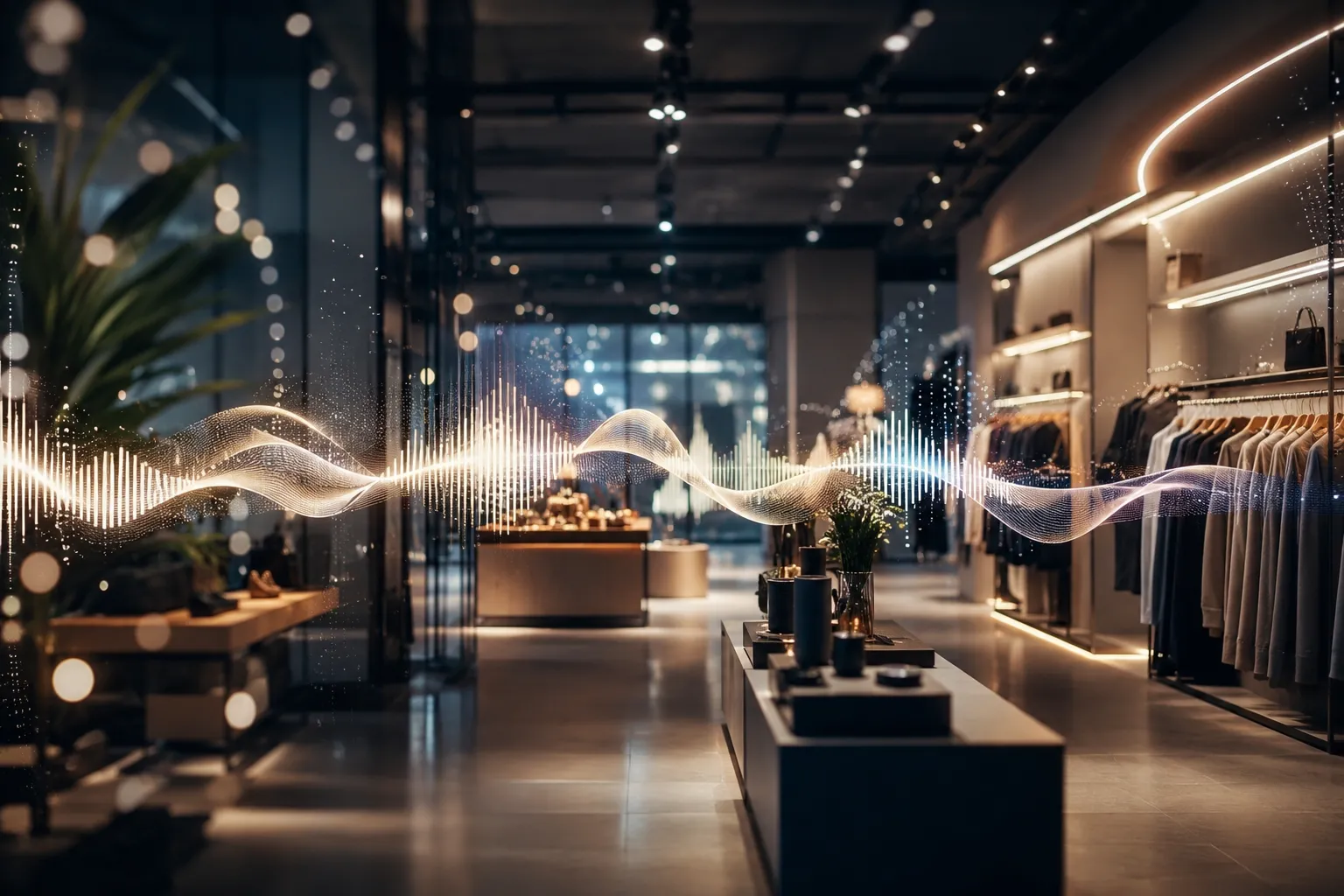

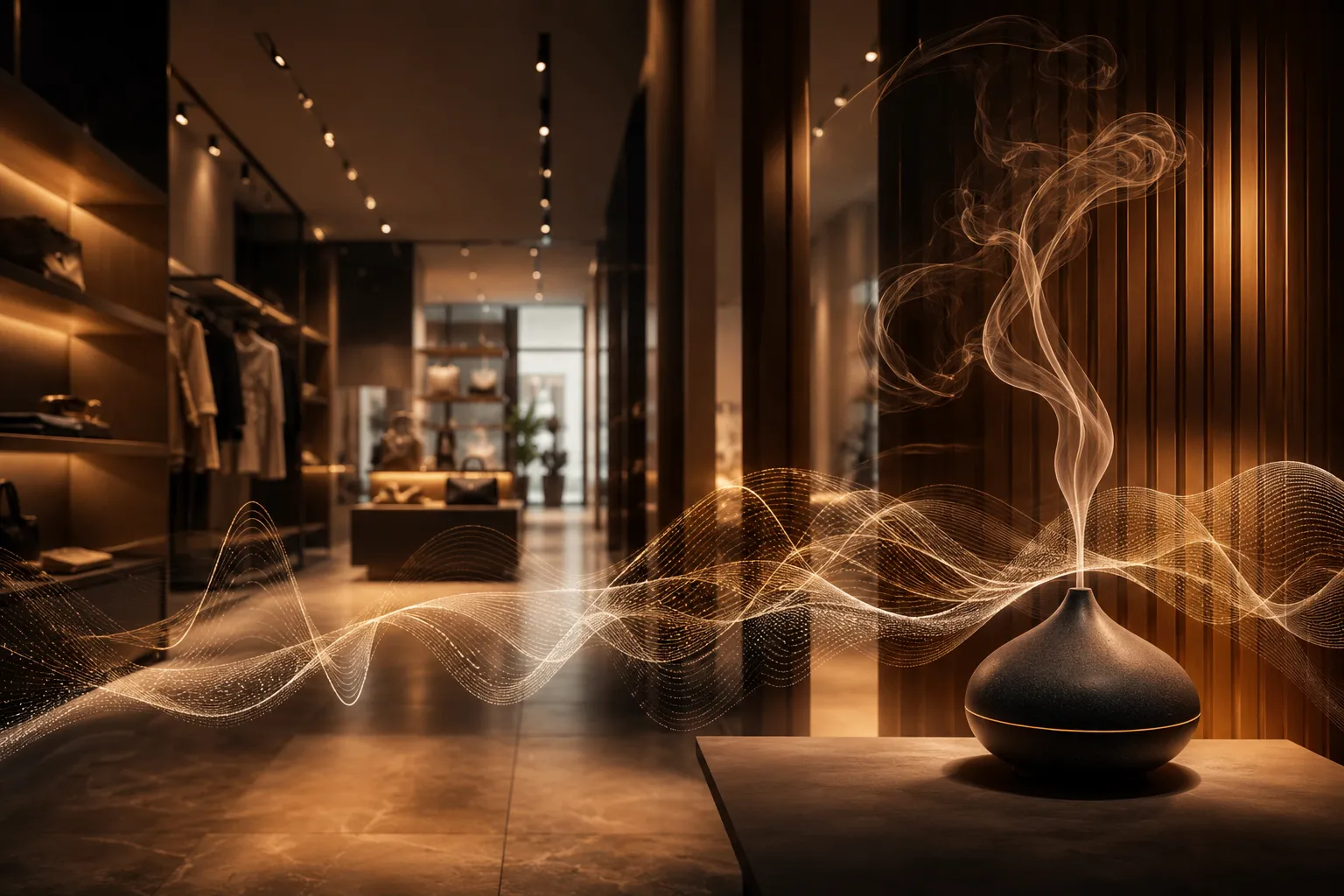
There are spaces we remember without really knowing why. Sometimes it has nothing to do with the product, the design or even the service itself. We walk into a shop and within a few seconds we experience a very specific feeling: we feel comfortable, we slow our pace, we unconsciously lower the tone of our voice. Some spaces manage to convey calm, others energy, and others a feeling that is difficult to explain yet instantly recognisable.
For years, retail designed shops to be looked at. Today, it is starting to design places to be felt — and that is a huge difference. For a long time, the point of sale was conceived primarily as a visual space: furniture, lighting, materials, packaging and visual merchandising. Then, almost always as a secondary layer, came music and scent. Important elements, certainly, but treated as accessories to the experience rather than an integral part of the brand’s identity.
Now, however, something is changing.
The most interesting shops are not simply becoming more technological or more visually impressive. They are beginning to be designed as coherent emotional experiences, where sound, atmosphere and sensory perception finally start speaking the same language.
And this is where multisensory retail stops being a simple marketing trend and becomes one of the most interesting evolutions in contemporary retail.
The problem is that many shops communicate conflicting emotions
It happens constantly, even among the most carefully curated brands.
We walk into an elegant boutique. Soft lighting, natural materials, refined visuals. Then a playlist starts that feels completely disconnected from the environment, or an overly aggressive, artificial or generic scent immediately breaks the initial feeling.
The opposite happens just as often: sophisticated music and a perfectly designed sound atmosphere paired with emotionally anonymous spaces lacking any real olfactory identity.
The issue is not the individual element.
The issue is coherence.
People do not experience their senses separately. The brain constantly builds connections between what it sees, hears and perceives. When those stimuli speak different languages, a feeling emerges that is difficult to describe yet instantly noticeable. It is the same difference between a technically well-made film and one that truly leaves something behind. It does not depend solely on the technical quality of the individual parts, but on the way they manage to create a coherent atmosphere.
This is exactly what is happening in retail. Even today, many spaces continue to design music, scent and environmental communication as independent elements, while the customer experiences them as one indivisible journey.
What is multisensory retail, really?
When people talk about multisensory marketing, they often imagine futuristic stores filled with technology, screens and special effects. In reality, the concept is far more subtle and, probably, far more powerful.
Multisensory retail is not about adding sensory stimuli to a space. It is about designing a coherent feeling.
The difference is enormous.
An effective multisensory environment does not necessarily need to amaze the customer. It needs to make them feel good almost without them noticing. It must convey a recognisable identity through the way light, music, scent, voice and spatial rhythm coexist together.
And this is where contemporary retail is starting to change direction.
For years, brands focused mainly on image. Today they are beginning to understand that human memory works on a much deeper level. Some of the most powerful sensations come from almost invisible elements:
- the sound of a space,
- the perceived rhythm of the environment,
- a recognisable fragrance,
- the way a place makes us feel.
A song can bring us back to a specific moment even years later.
A scent can instantly evoke memories.
A coherent environment can become recognisable before the customer has even truly looked at what is being sold.
This is probably why music and scent are beginning to change role within modern retail. No longer simple decorative tools, but part of the emotional identity of the brand itself.
Sound branding and scent marketing are starting to converge
Until a few years ago, those designing sonic identities rarely spoke with those working in olfactory marketing. They were separate worlds with completely different languages and approaches.
Today, that distance is beginning to shrink rapidly.
The reason is simple: brands are realising that people do not experience a shop in a rational and fragmented way. They experience an overall feeling.
And this is where concepts such as:
- sound branding,
- scent marketing,
- sensory branding,
- sensory in-store experience,
begin to intertwine.
Music influences the emotional rhythm of a space. Scent helps anchor its emotional memory. Together, they can build recognition, mental permanence and a far stronger perception of a brand’s identity.
It is no coincidence that many hotels, showrooms and premium boutiques are now working simultaneously on music, ambient scenting and spatial perception. Because today’s customer is not simply looking for beautiful spaces. They are looking for places capable of transmitting a precise feeling.
And this is a direction that companies such as MoosBox and Olfice are beginning to explore in increasingly interesting ways: not simply by providing “music for shops” or “ambient fragrances”, but by working on the idea of coordinated sensory experiences.
It may seem like a nuance.
In reality, it changes the entire perspective.
Retail scent marketing is undergoing a profound transformation
Scent marketing itself is also going through a significant evolution.
For years, the industry moved towards obvious standardisation: very similar fragrances, automatic diffusers and olfactory identities that often felt interchangeable. In many cases, scent was perceived simply as “presence”, not as language.
Today, however, customers are far more sensitive to the authenticity of environments.
An overly invasive or artificial fragrance is immediately perceived. On the contrary, a coherent olfactory signature almost disappears into the overall experience of the space, becoming a natural part of the atmosphere.
And this is where scent marketing truly changes approach.
Not towards stronger fragrances.
But towards more coherent olfactory identities.
This is probably why scent marketing is becoming central again right now: not because retail has suddenly discovered the power of ambient fragrance, but because it is beginning to understand the value of sensory coherence.
Artificial intelligence will make multisensory retail far more dynamic
There is another element that, over the next few years, could radically transform the way we experience commercial spaces: artificial intelligence.
When people talk about AI in retail, they almost always think about analytics, automation or customer care. Yet one of the most interesting evolutions could concern environmental experience itself.
Technology is beginning to make possible dynamic spaces capable of adapting atmosphere, communication and sensory rhythm according to the time of day, customer flow or even human behaviour.
Imagining:
- music changing throughout the day,
- voice communication aligned with the mood of the space,
- olfactory environments subtly adapting over time,
- synchronisation between sound, atmosphere and spatial perception,
no longer means talking about science fiction.
Many of these technologies already exist.
The real difference will lie in how they are used. Because the risk of creating artificial, excessive or almost “sensory theme park” environments is very real.
And this is probably where the smartest brands will emerge: those capable of using technology, AI and sensory branding discreetly, while keeping the naturalness of the experience at the centre.
Sensory experience will become one of retail’s greatest competitive advantages
Today, almost everything can be copied quickly:
- products,
- prices,
- visuals,
- store design,
- campaigns.
Feelings, however, are far more difficult to replicate.
And this is what makes multisensory marketing so interesting for contemporary retail. Because it builds something that goes beyond the product itself: the emotional perception of the brand.
A perception that influences comfort, dwell time, memory and even the way people unconsciously talk about the experience after leaving the shop.
The most interesting paradox is that, while retail becomes increasingly technological, the human aspect becomes even more important.
Because in the end, what truly remains is not the technology.
It is the feeling a space leaves behind.
FAQ – Multisensory marketing and sensory retail
What is multisensory retail?
Multisensory retail is an approach that uses music, scent, light, voice and other sensory elements to create a coherent in-store experience.
Why are music and scent important in shops?
Because they influence emotions, memory and brand perception, helping create more engaging and recognisable environments.
What is retail scent marketing?
Retail scent marketing uses ambient fragrances designed to strengthen identity, atmosphere and customer experience.
What is sound branding?
Sound branding is the strategic use of music and sound to build the emotional identity of a brand.
Will artificial intelligence influence multisensory retail?
Yes. AI will make environments increasingly dynamic, allowing music, communication and sensory components to adapt in real time.
Probably the future of retail will not be made of noisier, brighter or more spectacular shops. It will be made of more coherent environments. Because in the end, people easily forget what they saw inside a shop. Much more rarely do they forget how that place made them feel.
And perhaps this is the true evolution of multisensory marketing: stopping the design of separate elements and finally starting to design emotions.
Follow us on LinkedIn or join our Telegram channel to stay updated on the best music solutions for your business.