
In retail, people talk more and more about in-store radio.
The problem is that the term circulates far more than a real understanding of what it actually means.
For some, it’s a longer playlist.
For others, it’s music that “runs on its own”.
For others still, it’s simply a selection of well-known songs, so no one complains.
But an in-store radio is not designed to please everyone.
It is designed to make a space work better.
When it is confused with a playlist, it stops doing its job.
And the space loses coherence, rhythm, and identity.
In-store radio: a simple definition
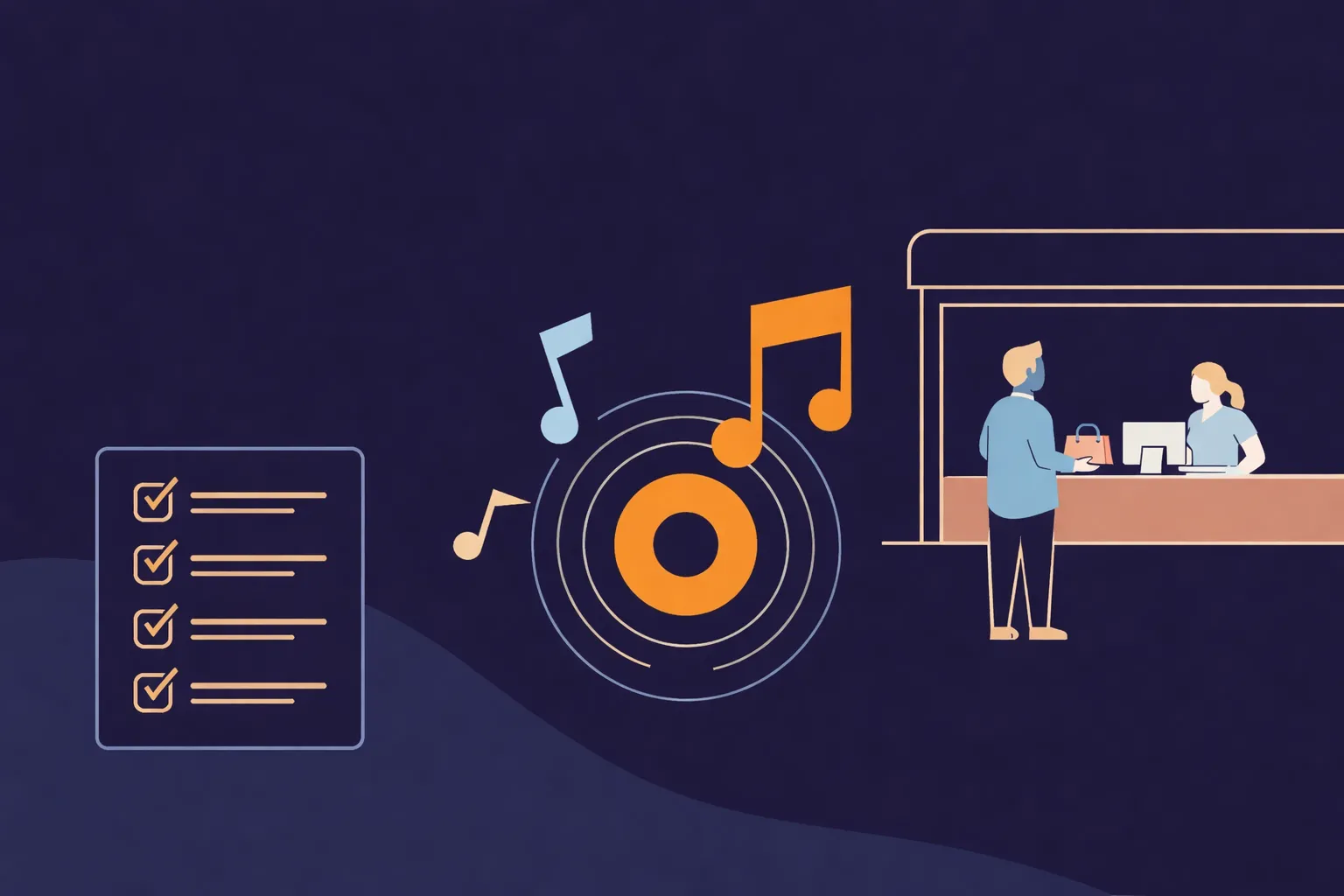
An in-store radio is a continuous and controlled music programming, designed to support the customer experience within a commercial space.
It is not a random selection.
It is not a one-time choice.
It is not “background music”.
It is an editorial system designed for retail.
For customers, this translates into a clear feeling:
the environment flows, it doesn’t tire, it doesn’t disturb.
For those who manage the space, it means control over:
- atmosphere
- timing
- sonic coherence
- brand perception
An effective in-store radio does not draw attention to itself.
But it makes the space more credible and easier to experience.
Playlist vs in-store radio: concrete differences
Here, the distinction is clear.
A playlist is content.
An in-store radio is a system.
In short:
- Playlist
- static
- repetitive
- indifferent to time of day
- detached from context
- In-store radio
- programmed
- dynamic
- organized by time slots
- coherent with the space
A playlist ignores time.
An in-store radio governs it.
For customers, the difference is subtle but real:
a space with a designed radio feels easier to move through.
A concrete example (for those who run a store)
Imagine a Saturday afternoon.
There’s high traffic, staff are under pressure, time feels compressed.
If the music is too aggressive, tension rises.
If it’s too slow, everything feels stuck.
A well-designed in-store radio shifts gear without being noticed:
it keeps energy without adding stress.
It keeps the space alive, without invading it.
The customer may not know why.
But they feel more comfortable.
The detail you only notice after an hour
Some differences only become clear over time: after 40–60 minutes in a space, a generic playlist starts to weigh on you. You may not notice it immediately, but it changes how you move, how long you stay, how comfortable you feel.
A designed in-store radio, instead, works in the opposite way: it doesn’t look for a “wow effect”, it looks for continuity. It is built to accompany, not to attract attention. And that’s exactly why it works.
Music quality: why it matters more than popularity
In retail, music quality matters more than fame.
Famous music is recognizable, but it brings external meanings with it:
personal memories, emotions, contexts that have nothing to do with the brand.
This creates a precise problem:
you lose control of the experience.
Non-mainstream music, instead, doesn’t ask for attention.
It works on atmosphere.
In an in-store radio, quality means:
- balanced arrangements
- controlled dynamics
- non-fatiguing timbres
- mixes designed for real spaces
- long-term listening without fatigue
Quality doesn’t impress at first listen.
Quality holds up after hours of presence.
And that’s where it makes the difference.
Mainstream music: why it’s only an alternative option
It’s important to be clear, without ideology.
Mainstream music is not wrong in absolute terms.
In some contexts it can make sense:
- when immediate recognition is needed
- when the brand explicitly requires it
- when the format justifies it
But it cannot be the foundation of a serious sound project.
In retail, the most famous song does not win.
The one that wins is the most suitable for the space.
That’s why, in a well-designed in-store radio:
- quality music is Plan A
- mainstream music is Plan B
Using it as a default is a shortcut.
Using it as an exception is a conscious choice.
What an in-store radio is made of
An in-store radio works when it is built on clear elements:
- schedule: defined time slots
- rhythm: different energy levels throughout the day
- sonic coherence: a recognizable stylistic line
- rotation: avoiding repetition and fatigue
- updates: continuity over time
Without these elements, it’s not a radio.
It’s just music playing.
How to tell if you really have an in-store radio
If you want a simple way to understand it, try this test. If you answer “yes” to three or more points, you probably don’t have a radio yet — just a playlist in disguise.
- The music is the same at 9 a.m. and at 7 p.m.
- After a few hours, staff lower the volume because it “gets tiring”
- You often hear the same tracks (or the same mood)
- There’s no clear logic of time slots
- The music doesn’t change when customer flow changes
A real in-store radio exists precisely to avoid this: it programs, rotates, updates — and above all, it keeps control of energy.
When an in-store radio makes sense
An in-store radio is particularly effective when:
- there are multiple locations
- staff turnover is frequent
- brand consistency is needed
- the day has different rhythms
- the goal is comfort, not surprise
In these cases, radio becomes an operational tool.
Not a detail.
Where MoosBox comes in
In daily work, the most common request is: “let’s put something that doesn’t bother anyone”. But the point isn’t avoiding annoyance — it’s creating continuity.
A well-designed in-store radio reduces internal decision noise (who chooses what), lightens staff workload, and makes the experience more consistent, even as people and moments change.
At MoosBox, we start from a simple principle:
an in-store radio is a continuous project, not an initial setup.
We don’t ask what music people like.
We ask:
- what kind of space it is
- who uses it
- how it changes throughout the day
- what kind of experience it should support
From here, an in-store radio is created that is:
- coherent
- flexible
- designed to last
It doesn’t seek attention.
It produces real effects on the experience.
In summary
An effective in-store radio:
- is not a long playlist
- is not based on famous songs
- is not a convenience choice
It is a designed musical system that uses quality as its primary lever and popularity only when it truly makes sense.
FAQ – Frequently asked questions about in-store radio
What is an in-store radio?
It is a continuous and controlled music programming designed to support the experience inside a commercial space.
What’s the difference between a playlist and an in-store radio?
A playlist is static. An in-store radio is a system that evolves over time.
Does it also work for small stores?
Yes. In fact, in smaller spaces the impact of a designed radio is often even more noticeable.
Should famous music always be avoided?
No. It can be used as an option, not as the foundation of the project.
Why is music quality more important than popularity?
Music quality in-store matters more than popularity because it must sustain long listening sessions, not attract immediate attention.
Well-produced, coherent, non-mainstream tracks reduce fatigue, maintain comfort, and allow music to truly work on the customer experience.
This is why quality music is the foundation of an effective sound project.
Learn how we work on in-store music quality
Follow us on LinkedIn or join our Telegram channel to stay updated on the best music solutions for your store.