

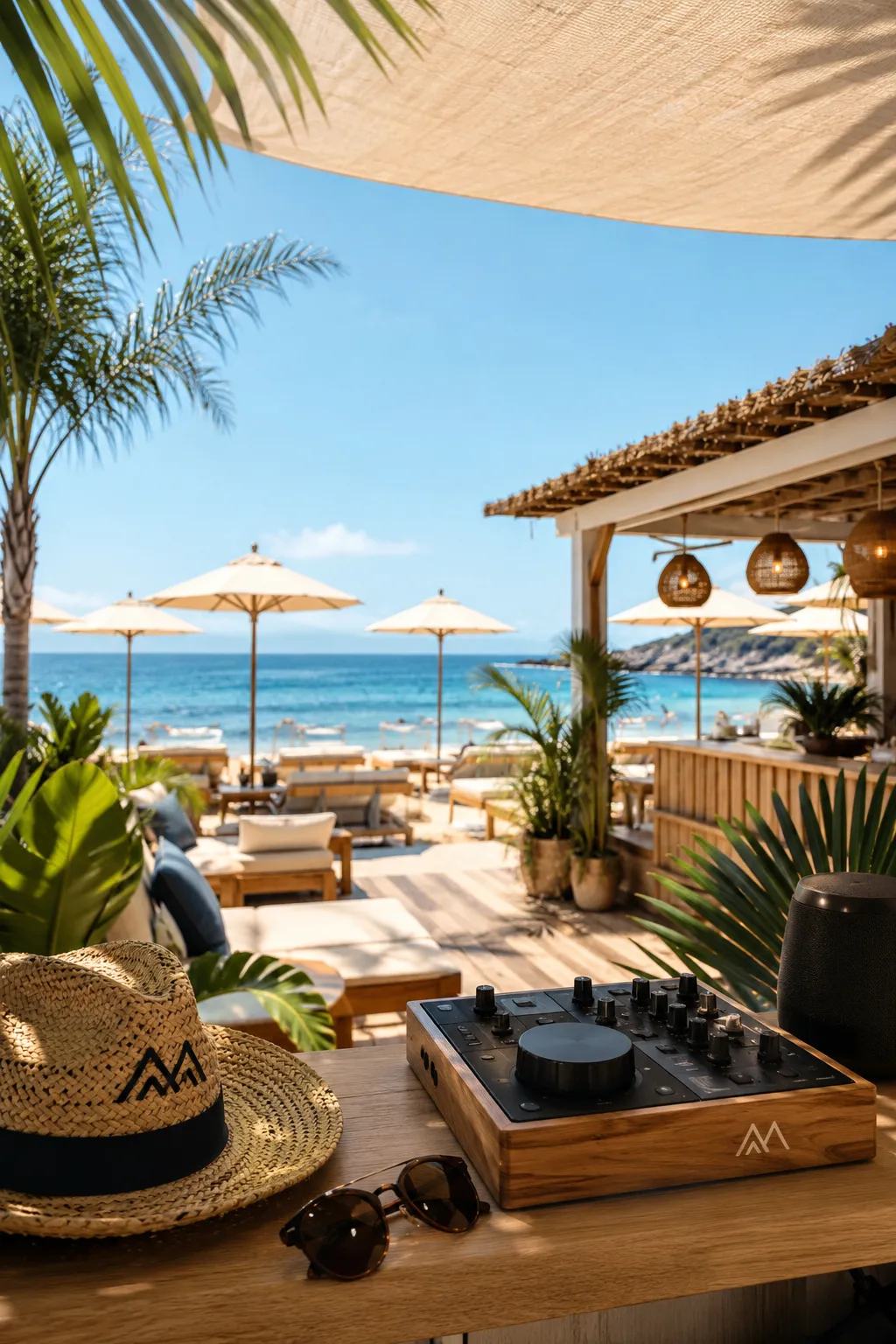
Music for beach clubs is becoming a huge problem
We walk into a stylish beach club by the sea. Carefully designed loungers, a relaxed atmosphere, refined interiors and premium cocktails.
Then the music starts.
And within a few seconds something strange happens: suddenly it feels exactly like the same place we were in the day before.
The same summer hits. The same house remixes. The same mainstream playlists we now hear everywhere — in seaside lounge bars, beach resorts, hospitality venues and even retail stores.
Over the last few years, music for beach clubs has become incredibly uniform. And it’s a much bigger problem than it seems, especially for venues investing heavily in creating a strong identity and standing out from competitors.
Because today people are not just looking for a beautiful location. They are looking for places with personality. And music has become a huge part of that experience.
Music for beach resorts: why mainstream playlists are no longer enough
For years, the hospitality industry followed a simple idea: use familiar music to create instant atmosphere.
It worked.
But audiences have changed. People now spend far more time in beach clubs than they used to. They work from their phones, enjoy long lunches, spend entire afternoons on sunbeds and often stay until sunset drinks.
And when you spend six or seven hours in the same environment, you start noticing everything much more clearly. Including the music.
Many beach club playlists are designed to grab attention instantly, not to genuinely support a long, comfortable experience. At first they work. After a while they become exhausting.
Not because the music is bad, but because it’s aggressive, repetitive and, above all, exactly the same everywhere.
This is where many beach resorts are making the same mistake: confusing energy with constant noise.
Daytime music is the hardest part to manage in beach clubs
When people talk about hospitality music, they usually think about sunset drinks or evening vibes. In reality, the most delicate part of the day is daytime.
Sound comfort matters more than volume
Creating atmosphere for thirty minutes is relatively easy. Making people feel good throughout an entire day without turning music into an invasive presence is much harder.
And yet, step into many beach clubs and you’ll hear the same issues over and over again: volume already too loud by late morning, playlists built from identical algorithms, endless mainstream hits and no real sonic identity.
After a few hours, the music stops creating atmosphere and simply becomes constant background noise.
Guests may not analyse it rationally. But they definitely feel it.
That’s why some beach clubs make us want to stay until evening, while others start feeling tiring after just a couple of hours.
Premium beach clubs are looking for more fluid environments
Today, luxury in hospitality is no longer just visual. It is increasingly connected to the overall comfort of the experience.
People are beginning to notice details that once went completely unnoticed: overly noisy spaces, repetitive playlists and atmospheres designed more for social media than for genuine wellbeing.
And this is exactly where music for seaside lounge bars and beach clubs is starting to change direction.
The problem with mainstream playlists in beach clubs
In recent years, much of the beach music we hear in beach clubs has become painfully predictable.
The same hits. The same summer moods. The same tracks moving endlessly from one playlist to another until completely different venues end up sounding almost identical.
When beach aperitif music starts sounding the same everywhere
Beach aperitif music is probably where this standardisation becomes most obvious.
It should be one of the most recognisable moments of the hospitality experience. Instead, it often feels exactly the same everywhere.
Same tracks.
Same rhythms.
Same sonic structure.
The result is that many beach clubs lose personality precisely when they should stand out the most.
The cost of mainstream music in beach clubs is often underestimated
There’s another topic that the hospitality industry still talks about far too little: the real cost of commercial music.
Many beach resorts continue relying on mainstream playlists without realising how expensive the system can become over time through music licensing fees, performance rights organisations, subscriptions and commercial music licences.
And the paradox is obvious.
Many beach clubs, outdoor pools and hospitality venues spend thousands every year to play exactly the same music as competitors located just a few hundred metres away.
Same hits.
Same atmosphere.
Same sonic experience.
For hospitality groups, seasonal chains and food & beverage franchises by the sea, this is becoming a very concrete issue.
Because today music is no longer just an operational cost. It’s part of a brand’s identity.
More and more beach clubs are looking for alternatives to mainstream playlists
In recent years, many hospitality venues have started searching for a different approach to beach club music.
Not only to stand out, but to create environments that feel more coherent, less tiring and more recognisable throughout the entire day.
The goal is not to play “strange” or overly niche music. Quite the opposite.
The beach clubs that work best are often the ones where the music simply feels right within the space. Where the sound supports the atmosphere without taking over completely. Where people can stay for hours without feeling trapped inside an endless playlist of repetitive summer hits.
That’s also why companies like MoosBox are increasingly working on a different approach to hospitality music — one focused more on sonic identity and continuity of experience than on simply rotating mainstream hits.
You can feel the difference almost immediately.
Not because the music is more “unusual”, but because after several hours the environment still feels balanced and enjoyable.
And that’s far rarer than it should be.
The future of beach clubs will be increasingly linked to sonic identity
For a long time, many venues believed that playing familiar music and slightly increasing the volume was enough to create atmosphere.
Today, it isn’t enough anymore.
People are looking for places with character, personality and genuine comfort. Places that don’t feel like the sonic copy of a hundred other beach clubs.
And this is probably where one of the biggest differences will emerge over the next few years.
Because venues that continue relying on copy-and-paste playlists risk slowly becoming completely interchangeable.
Even with the sea right in front of them.
FAQ – music for beach clubs and beach resorts
Why do so many beach clubs sound the same today?
Because they use the same mainstream playlists, the same summer hits and the same music algorithms, losing their sonic identity.
What’s the problem with mainstream hits in beach clubs?
Commercial hits can become repetitive and exhausting during long stays, especially in beach resorts where guests spend many hours in the same environment.
Is daytime music harder to manage?
Yes. During the day, music needs to support the atmosphere without becoming invasive, maintaining comfort for many consecutive hours.
Does mainstream music involve additional costs?
Yes. Using commercial music catalogues often involves licensing fees and payments to music rights organisations and related operators.
Are there alternatives to mainstream playlists?
Yes. More and more hospitality venues are choosing music solutions that are more personalised and aligned with their own identity.
If you want to stay updated with the latest MoosBox news, follow us on LinkedIn or join our Telegram channel.